Pomp, pageantry but precious little to show for Trump’s Beijing excursion
https://www.theguardian.com/us-news/2026/may/16/donald-trump-xi-jinping-summit-china
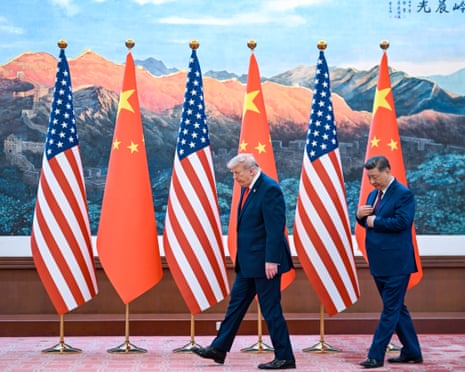
Pomp, pageantry but precious little to show for Trump’s Beijing excursion
No swift end to the Iran war, uncertainty over Taiwan and only vague outlines of commercial deals … but the US president did get to bask in the company of Xi Jinping
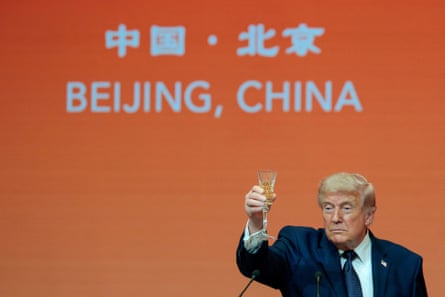
It was historic, to be sure, but not as anyone had predicted. First there was Donald Trump, a self-declared teetotaler, apparently drinking champagne after Xi Jinping assured him that China’s “great rejuvenation” could go hand in hand with “Make America great again”. Then there was a Chinese military band playing a rendition of the US president’s signature campaign song, YMCA.
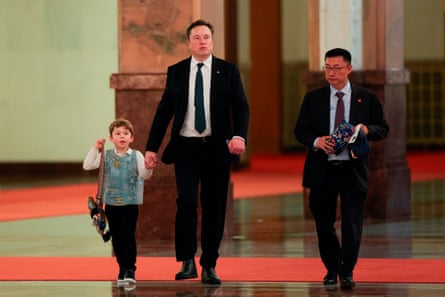
Beneath giant chandeliers, blue and gold balconies and a big orange backdrop with pagoda-style roofs, Thursday’s state banquet in Beijing featured characters whose presence would have been unthinkable here a decade ago: Elon Musk, the eccentric tech billionaire, Pete Hegseth, the Fox News host turned “secretary of war”, and of course Trump himself, a former reality TV star now leading the world’s biggest superpower.
As the guests dug into a quirky menu that included lobster in tomato soup, crispy beef ribs, Beijing roast duck and slow-cooked salmon in mustard sauce, the mood was convivial after the first day of a summit that had offered cosy choreography and the promise of stability in the world’s most important bilateral relationship.
But by the time Trump and his entourage boarded Air Force One on Friday, the generous helpings of food might not have been enough to stave off an empty feeling. He came, he saw, he left without much to show for it: no swift end to the war in Iran, no definitive answer on the fate of Taiwan and only the vague outlines of corporate mega-deals. Underwhelmed observers suggested that the summit failed to live up to the hype.
“It was heavier on symbolism than it was on substance,” Rush Doshi, director of the China Strategy Initiative at the Council on Foreign Relations thinktank in Washington, told reporters. “There was a focus on managing problems, not on solving the problems that exist between the US and China … A lot of pomp, a lot of pageantry, a lot of symbolism but not a lot of substance or deliverables.”
The Beijing that greeted Trump is oozing self-confidence. Commuters cram into smooth-running subway trains and find just enough room to scroll through slick social media apps. Designer labels from around the world populate luxury shopping malls. The magnificent National Centre for the Performing Arts rests like a titanium and glass boiled egg in an artificial lake. The National Museum on Tiananmen Square shows off the latest advances in green energy, robotics and space exploration and proclaims: “Forging the path to national strength.”
America, meanwhile, is plagued by self-doubt over its internal divisions and external misadventures. Sensing a potential shift in the balance of power, Xi urged the two nations to avoid the “Thucydides Trap”, the historical concept that an established power tends to be threatened by a rising one, leading to an inevitable clash.
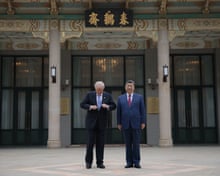
The summit, held partly in the ornate surroundings of Zhongnanhai – the secretive Communist party leadership compound often likened to a Chinese Kremlin or White House – unfolded with pageantry and fanfare.
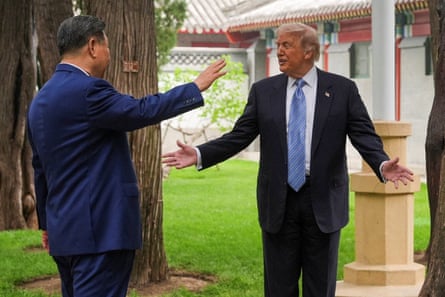
Xi personally escorted the US president through manicured gardens filled with centuries-old trees and Chinese roses. Trump marvelled at them as “the most beautiful roses anyone has ever seen”, prompting Xi to promise he would send him seeds.
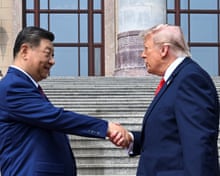
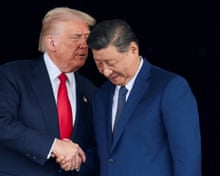
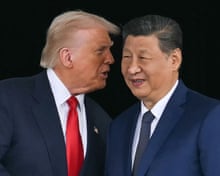
Beijing appeared determined to flatter a president known to value personal diplomacy and spectacle. Trump responded in kind, repeatedly praising Xi as “all business” but also “a warm person”, adding: “We’ve settled a lot of different problems that other people wouldn’t have been able to settle.”
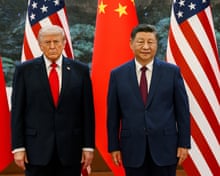
The Chinese leader described the visit as “historic”, saying the two countries had agreed on “a constructive, strategic and stable China-US relationship”. Chinese officials suggested the framework could guide relations for the remainder of Trump’s presidency.
George Chen, a partner at the consultancy The Asia Group, told the Associated Press that the summit resembled “a political reality show at times” but both sides had achieved something important by simply restoring direct leader-to-leader rapport after months of escalating tensions.
Chen added: “The readouts from Beijing and the White House differ in tone and emphasis but neither side contradicted the other’s account. That alone reflects a rare moment of mutual respect.”
‘Clashes and even conflicts’
Still, the disagreements were profound. Nothing loomed larger over the talks than Taiwan, the democratic island claimed by Beijing as Chinese territory and viewed by many analysts as the most likely trigger for a US-China war.
Xi used the summit to warn Trump in unusually stark terms that mishandling Taiwan could propel China and the US towards “clashes and even conflicts”.
Trump later claimed that Xi asked directly whether the US would defend Taiwan if China attacked the island but Trump declined to answer. “There’s only one person that knows that, and it is me,” he told reporters later. “I’m the only person.”
For decades, the US adopted a policy of “strategic ambiguity” towards Taiwan but then president Joe Biden was explicit in saying he would use military force to defend the island. China, meanwhile, has sharply intensified military pressure on Taiwan in recent years and has never renounced the use of force to seize the island.
Ahead of the summit, Trump had hinted he might reconsider a massive $11bn weapons package for Taiwan approved last year by his administration. The sales have not yet been implemented and Beijing has made clear it views them as a core test of US intentions.
Speaking onboard Air Force One on Friday, Trump said only that he would make a decision “over the next fairly short period of time”.
That vagueness is likely to alarm officials in Taipei, who have watched Trump’s rhetoric on Taiwan with increasing nervousness. He has repeatedly complained that Taiwan “stole” America’s semiconductor industry and demanded the island pay more for its own defence.
If Taiwan represented the long-term strategic danger, Iran dominated the immediate agenda. China remains Iran’s biggest oil customer. Trump emerged from his meetings with Xi insisting that China and the US were broadly aligned over the conflict, now in its 11th week after US and Israeli strikes on Iran on 28 February.
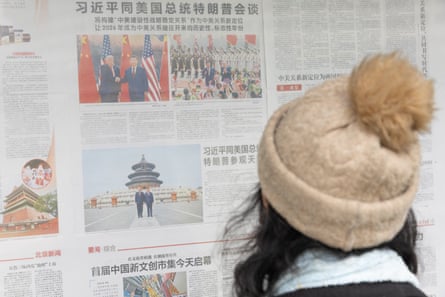
“We don’t want them to have a nuclear weapon,” Trump said beside Xi. “We want the straits open.”
The strait of Hormuz – through which roughly one-fifth of the world’s oil previously flowed – has been effectively closed since the outbreak of the war. The resulting disruption has sent oil prices surging towards $109 a barrel and raised fears of a global recession. Rising gas prices in the US have also dragged Trump’s approval rating to an all-time low.
Trump claimed Xi had agreed that Tehran must reopen the waterway and had promised China would not supply Iran with military equipment. “That’s a big statement,” Trump said later in a Fox News interview.
Beijing’s own public statements were more restrained. China’s foreign ministry bluntly declared that the conflict “should never have happened” and called for shipping routes to reopen but stopped short of endorsing Trump’s approach.
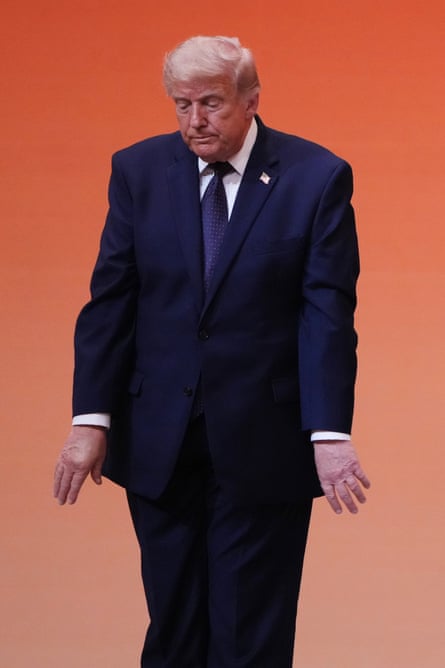
Trump also returned from Beijing promising sweeping commercial gains and “fantastic trade deals”. He claimed that China would buy “billions of dollars” worth of American agricultural goods, particularly soybeans, offering a potential lifeline to US farmers who have suffered badly from years of trade tensions and Chinese diversification towards Brazilian suppliers.
The US trade representative, Jamieson Greer, said Washington expected “double-digit billions” in agricultural purchases over the next three years. Trump added: “The farmers are going to be very happy.”
Trump announced what could become one of the biggest aircraft deals in history, saying China had agreed to purchase 200 Boeing aircraft immediately, with the possibility of expanding the order to 750 jets if the arrangement proved successful. But Chinese officials did not confirm the deal.
One of the more surprising announcements concerned nuclear arms control. Trump said he had proposed a trilateral agreement among the US, Russia and China to cap nuclear arsenals. “I got a very positive response,” he said. “This is the beginning.”
But hopes that Trump and Xi might put the brakes on the uncontrolled development of AI were seemingly dashed. Despite the presence of Musk, who pulled funny faces when asked for photos, Apple’s Tim Cook, chipmaker Nvidia’s Jensen Huang and other tech executives, there were no obvious signs of new guardrails in the AI arms race between the two countries.
Unnaturally subdued
The talks also touched on human rights, albeit briefly. Trump said he had raised the cases of the imprisoned Hong Kong media tycoon Jimmy Lai and detained Chinese pastor Jin Mingri. Xi appeared more open regarding the latter, according to Trump.
“I think he’s giving very serious consideration to the pastor,” the president said. But Lai’s case was “a tough one”.
For a president who normally commands the spotlight with daily, freewheeling press interactions, Trump was unnaturally subdued in Beijing. In what appeared to be an act of deference to Xi, Trump kept quiet during public appearances at the Temple of Heaven and Zhongnanhai.
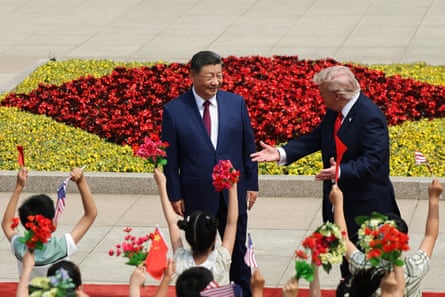
Even his notoriously hyperactive social media feeds went largely dormant during the two-day swing. Critics of the president’s authoritarian tendencies at home are likely to suggest he had found a kindred spirit in illiberal China and has not shown such affection towards another leader since meeting Russia’s Vladimir Putin in Alaska.
Asked by reporters if he considered Xi to be a dictator, Trump replied: “I don’t think about it. He’s the ruler, he’s the president of China. I don’t think about it. You have to deal with what you have. I respect him. He’s very smart. He loves his country, I respect him, whether he’s a dictator, that’s for you to figure out.”
As Trump’s visit concluded, the Chinese government orchestrated a farewell as meticulously staged as the welcome. Schoolchildren clad in the light blue and white colours of Air Force One waved flags in coordinated precision, chanting “Warm farewell!” on the tarmac.
Smiling alongside the Chinese foreign minister, Wang Yi, Trump pumped his fist, turned at the top of the stairs, and vanished into the aircraft without taking a final question – and with some of the most dangerous fault lines in global politics unresolved by his status quo summit. But he did draw one conclusion.
“China has a Ballroom, and so should the U.S.A.!” he wrote on social media alongside a photo of himself and Xi outside the Great Hall of the People. He was already back to his pet project, a new $400m ballroom at the White House. Whereas past US presidents used to urge China to become more like America, this one seemed intent on making America more like China.
Democrats condemned Trump for squandering an opportunity. Ten senators including Jeanne Shaheen, ranking member of the Senate foreign relations committee, and Chris Murphy said in a joint statement: “President Trump failed to use his summit with Chinese President Xi Jinping to advance any objectives important to the American people – to counter China’s unfair trade practices and military aggression, preserve American technological and economic leadership, stand up for human rights or strengthen deterrence to prevent a conflict over Taiwan.”
The group added: “While US forces are engaged in hostilities against Iran, President Trump refrained from confronting President Xi on China’s extensive support for the Iranian regime and its sharing of intelligence directly contributing to attacks against US forces – a clear dereliction of his duties as commander-in-chief.”
At this dangerous time
We hope you appreciated this article. Before you close this tab, we want to ask if you could support our annual press freedom appeal at this dangerous time for journalism in the US.
According to a leading global watchdog, American democracy is now more imperiled than at any point since the 1960s, marked by a precipitous decline in press freedom – driven by mounting pressure from the Trump administration in the form of threats, criminal investigations, politicized regulation, frivolous lawsuits and, for public media, catastrophic funding cuts.
Meanwhile, organizations that are supposed to be independent like the FBI and the FCC, our radio and television regulator, have also been targeting press freedom under Trump-aligned leadership, with the FBI raiding a reporter’s home and the FCC threatening ABC’s TV licenses after Jimmy Kimmel made a joke about Melania Trump.
The response from some ultra-wealthy and corporate media owners, keen to appease the president, has been chilling: CBS News has been taken over by a Trump ally; CNN is poised to be taken over by the same billionaire; Jeff Bezos has continued to impose cuts and editorial interventions at the Washington Post; and multiple outlets have settled multimillion-dollar lawsuits from the administration to protect their business interests.
Democracy is best served by a robust, thriving free press. But when that freedom is under attack, it falls to a determined few news organizations to ensure the full truth still reaches the public. Owned neither by a billionaire nor a corporation, the Guardian remains dedicated to covering this administration with uncompromising moral and factual clarity – and to keeping trustworthy journalism paywall-free for the world.
Despite the risks of maintaining our fierce independence, what sustains us – and fills us with deep gratitude – is the unwavering support we’ve seen from readers. It is no exaggeration to say that we are here because of you: a majority of our funding comes directly from people like you responding to messages like this. Your support not only powers our work, but more importantly, it safeguards the financial independence that underpins our editorial freedom and courage.
In honor of World Press Freedom Day this month, we’re looking for 60,000 readers to support our annual appeal with $5 or more. Do you have the means to be one of them? We’re especially grateful for anyone able to set up a monthly contribution: reliable funding is vital for sustaining us throughout this dangerous period, right to its end.
We would be hugely grateful for your backing to mark this global day of solidarity for independent journalism. Anything you can spare goes directly toward our work – not into the pockets of a billionaire or corporation with other interests at heart. It takes less than a minute. Thank you for protecting the truly free press.






No comments:
Post a Comment