Saturday, May 31, 2025

A New Working-Class GOP? If “Working-Class” Means $4.3 Million a Year!

 https://newrepublic.com/article/195867/working-class-gop-trump-plutocrats

The New Republic


OLD “WHINE”

A New Working-Class GOP? If “Working-Class” Means $4.3 Million a Year!

Last year, Trump won praise for building a new GOP. But the Big, Beautiful Bill utterly shatters the illusion that he is some sort of brilliant policy innovator.

Trump sits, leaning on the arm of an upholstered sofa.
Oleg Nikishin/Getty Images 

So much for a new, “populist” Republican Party. So much for the GOP as a brave band of fiscally prudent, anti-deficit hawks. The “Big, Beautiful Bill” is a declaration of intellectual bankruptcy, policy incoherence, and political vacuousness. That’s its formal name, by the way, and you’ve already admitted a problem when you have to sell something that hard.

It’s no wonder that the only way the BBB passed the House was for one opponent to vote “present” and for two others to miss the vote. One of the absent members fell asleep and missed the vote, an entirely appropriate response to an exercise in philosophical exhaustion. Defending the bill requires twisting facts into the “alternative” variety and turning the plain meaning of words upside down.

For example: The right wingers who demanded more cuts in programs for low-income people are regularly described as “deficit hawks.” But even if they had gotten all the changes they sought, the bill would have massively increased the deficit. And most of them voted for a final product that will add close to $4 trillion to the nation’s indebtedness.

If these guys are hawks, I don’t know what a dove looks like.  

Trump and his backers continue to insist that they are building a new working-class Republican coalition. But the astonishing thing about this bill is not only that it lavishes tax cuts on the very well-off; it also takes money away from Americans earning less than $51,000 a year once its cuts in Medicaid, the Affordable Care Act, SNAP, and student loans are counted for. Republicans who rail against “income redistribution” are doing an awful lot of redistribution themselves—to those who already have lots of money.

The Penn Wharton budget model of the near-final version of the bill found that Americans earning less than $17,000 would lose $1,035 under its terms. Those earning between $17,000 and $50,999 would lose $705. But the small number of our fellow citizens who earn more than $4.3 million a year have a lot to cheer about: They pick up $389,280 annually.

Please explain to me again why this is a “populist” Republican Party.

It’s imperative not to miss what’s obvious about this billthat it ravages lower-income people to benefit the very privilegedand for progressives and Democrats to act on this.

But it’s also essential to notice what doesn’t get enough attention: that so much of the commentary about how Trump has reinvented the GOP with a fresh set of ideas and commitments is poppycock. Trumpism is certainly dangerous and authoritarian in new ways. It is, well, innovative when it comes to a vast and unconstitutional expansion of presidential power.

But it’s also an ideological mess riddled with contradictions. When you look below the hood, it’s primarily about the interests of people who can buy their way into Trump’s golf clubs and private pay-for-play dinnersand, especially, about the enrichment of Trump and his family.

On the phony populism side, Democrats in the House did a generally good job of highlighting the costs of provisions in the bill that hurt so many of Trump’s voters, particularly the cuts in Medicaid and nutrition assistance, or SNAP. Senate Democrats have already ramped up similar efforts as that body’s Republican leaders prepare to grapple with the steaming pile of incongruities the House has sent their way.

You can tell that Republicans know how unpopular the Medicaid cuts in the bill are because they delayed their effectiveness date to minimize their electoral effect, repeatedly denied they are cutting Medicaid—and don’t want to talk at all about how slashing subsidies within the Affordable Care Act would take health coverage away from millions more Americans.

They are hiding the Medicaid cuts behind “work requirements” that are really bureaucratic paperwork requirements that would make it much harder for people with every right to coverage to access it. They would make it more difficult for others to maintain continuous coverage. And if these rules were not about “cutting” Medicaid, the GOP couldn’t claim to be “cutting” roughly $700 billion in Medicaid spending.

But the GOP thinks it has a winner in its work argument. It’s a tired but tested replay of a very old (and, yes, offensive) trope about alleged grifters among supposedly “lazy” poor people. House Speaker Mike Johnson offered a remarkable version of this defense of the “work” provisions: He said they were aimed at “the young men who need to be out working instead of playing video games all day.” If ever there was a quote that should go viral, this is it. Young men, after all, shifted toward the Republicans in 2024. They should know what the party many of them voted for thinks of them.

More important, progressives need to take the work argument on directly, not only by showing that the work provisions aren’t really about work but also by offering amendments replacing the Medicaid cuts with provisions that actually would expand the availability of well-paying opportunities for greater self-sufficiency. Restoring the clean energy tax credits are important not only to battling climate change; they’re also about preserving and creating well-paying jobs. A package of proposals on affordable housing, job training, and access to community colleges, particularly in economically depressed areas, would make a nice contrast to those who deny that government has the capacity to improve lives.

What the Financial Times’ economics columnist Martin Wolf nicely termed “pluto-populism” when the GOP passed the 2017 tax cuts that this bill extends is alive and well. That populist rhetoric is being married to plutocratic policies is still not recognized widely enough. This is certainly a commentary on the rightward tilt of the media system the editor of this magazine has called out. But it also reflects a failure of Democrats to take the argument to the heart of Trump’s base.

It’s political common sense that parties focus most of their energy on swing states and swing districts. Yet there will be no breaking the 50-50 deadlock in our politics without a concerted effort to change the minds of voters who have drifted to Trump out of frustration with their own economic circumstances and the condition of their regions. The fight over Medicaid and SNAP cuts directly implicates these voters and these places.

And these voters pay more attention to these issues than either the Republicans who take them for granted or Democrats who have given up on them believe.

When Andy Beshear won his first race for governor of Kentucky in 2019, he not only mobilized Democrats in urban areas; he also flipped many rural counties and cut the Republicans’ margins in others. Typical was Carter County in eastern Kentucky. The county went for Beshear even though it had backed his GOP opponent and then-incumbent Republican Governor Matt Bevin four years earlier and gave Trump 73.8 percent of its ballots in 2016. Breathitt County in Appalachia also flipped, having gone for Bevin and voted 69.6 percent for Trump.

Fred Cowan, a former Kentucky attorney general and a shrewd student of his state’s politics, told me then that these voters understood where their interests lay. “In a lot of these counties, the school systems or the hospitals—or bothare the biggest employers,” he said “The Medicaid expansion helped a lot of people over there.”

Sure, it’s easier for Democrats like Beshear with strong local profiles to make their case. But the national party needs to learn from these politicians that giving up on whole swaths of voters is both an electoral and moral mistake.

The emptiness of Republican populism speaks to the larger problem of mistaking Trump’s ability to create a somewhat new electoral coalition with intellectual and policy  innovation. Some conservative commentators are honest enough to admit how the BBB demonstrates that the “old Republican Party is still powerful, the old ideas are still dominant,” as Ross Douthat observed in The New York Times.

But even Douthat wants to cast the bill as an exception to a bolder transformation the president has engineered, particularly around immigration and a “Trumpian culture war.” The problem here is that none of this is new, either.

The GOP was moving right on immigration well before Trumpwhen, for example, it killed George W. Bush’s immigration bill in 2007 as right-wing media cheered it on. The culture war and the battle against universities are old hat too. The real innovator here was the late Irving Kristol, whose columns in the 1970s introduced Wall Street Journal readers to the dangers posed to business interests by “the new class” of Hollywood, media, and university types, along with activist lawyers. True, Trump is taking this fight to extreme places Kristol would never have gone. But, again, there’s no new thinking here.

And the attack on trans rights is just the latest front in the LGBTQ+ debates, now that the right has had to abandon its opposition to same-sex marriage because Americans have come to support it overwhelmingly.

Even the contradictions aren’t new. Since the Reagan years, Republicans have always talked about the dangers of deficits when Democrats were in power but cast those worries aside when they had the power to cut taxes. “Reagan proved deficits don’t matter” is the canonical Dick Cheney quote from 2002 when he was pushing for more tax cuts in W.’s administration. The exception proves the rule: George H.W. Bush made a deal with Democrats in 1991 that included tax increases because he really did care about deficits—and conservatives never forgave him for it.

In an odd way, you have to admire Cheney’s candor: At least he admitted what he was doing. The Freedom Caucus members have the gall to yell at the top of their lungs about how they care so very much about the debtand then vote in overwhelming numbers to pile on billions more.

As the debate over the BBB moves to the Senate, the immediate imperative is to expose the damage the bill does to millions of Trump’s voters to benefit his Mar-a-Lago and crypto-wealthy friends. But it’s also an occasion to shatter the illusion that Trump is some sort of brilliant policy innovator. Extremism and authoritarianism are not new ideas, and his legislative program would be familiar to Calvin Coolidge. 

Editor’s Picks
  • https://grist.org/food-and-agriculture/trump-budget-bill-is-on-the-verge-of-transforming-how-america-eats/

    https://grist.org/food-and-agriculture/trump-budget-bill-is-on-the-verge-of-transforming-how-america-eats/

    Early this month, after some equivocation, President Donald Trump briefly endorsed the idea to hike taxes on the wealthiest Americans in his budget proposal to Congress. Economists were quick to point out the meager impact a new millionaire tax bracket would have on the ultra-rich, particularly in the context of other proposed tax cuts that would offset any pain points for them. Still, the backlash from Republican members of Congress was swift. They spurned the proposal and instead advanced breaks for wealthier Americans. Last week, that version of Trump’s “big, beautiful” tax bill narrowly passed the U.S. House of Representatives and headed to the Senate. 

    Tax policy isn’t the only way that this bill proposes to further widen the gap between the wealthy and the poor. Though the more than 1,000-page megabill will look somewhat different once it advances through the Senate, analysts say that there are three food and agricultural provisions expected to remain intact: an unprecedented cut to the nation’s nutrition programs; an increase of billions in subsidies aimed at industrial farms; and a rescission of some Inflation Reduction Act funding intended to help farmers deal with the impacts of climate change.

    Reader support makes our work possible. Donate today to keep our site free. All donations DOUBLED!

    If they do, the changes will make it harder for Americans to afford food and endure the financial toll of climate-related disasters. They will also make it more difficult for farmers to adapt to climate change — from an ecological standpoint and an economic one. Overall, the policy shifts would continue Trump’s effort to transform the nation’s food and agricultural policy landscape — from one that keeps at least some emphasis on the country’s neediest residents to one that offers government help to those who need it least.


    Ever since the inception of the federal food stamps program in 1939, when it was created during the Great Depression to provide food to the hungry while simultaneously stimulating the American economy by encouraging the purchase of surplus commodities, what’s now known as the Supplemental Nutrition Assistance Program, or SNAP, has been falsely portrayed as a contributor to unemployment rates and politicized as an abuse of taxpayer dollars. 

    A vast body of research has found the opposite: roughly 42 percent of SNAP recipients are children, more than half of adult recipients who can work are either employed or actively seeking employment; the program’s improper payments are most often merely mistakes made by government workers or eligible households, not cases of outright fraud; and the benefits keep millions of Americans out of poverty

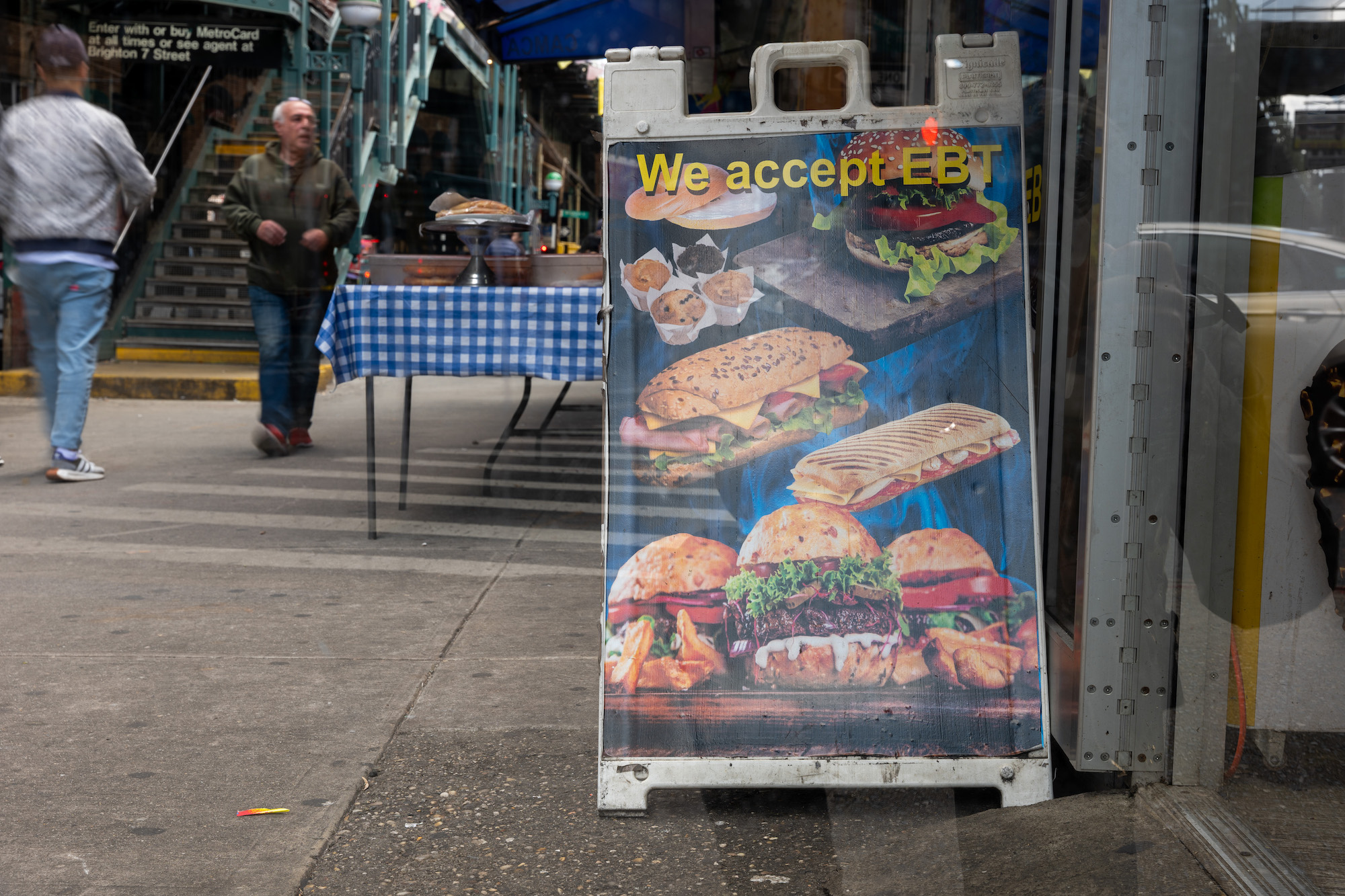
    A sign with pictures of food saying we accept EBT
    A sign outside of a grocery store in 2023 welcomes those on food assistance in a Brooklyn neighborhood that has a large immigrant and elderly population.
    Spencer Platt / Getty Images

    Right now, more than 40 million Americans are enrolled in SNAP, an anti-hunger program written into the farm bill and administered through the Department of Agriculture’s Food and Nutrition Service. The federal government has always fully paid for benefits issued by the program. States operate the program on a local level, determining eligibility and issuing those benefits, and pay part of the program’s administrative costs. How much money a household gets from the government each month for groceries is based on income, family size, and a tally of certain expenses. An individual’s eligibility is also constrained by “work requirements,” which limit the amount of time adults can receive benefits without employment or participation in a work-training program. 

    The Congressional Budget Office estimated that the cuts to SNAP now being proposed could amount to nearly $300 billion through 2034. An Urban Institute analysis of the bill found that the cuts would be achieved by broadening work requirements to apply to households with children and adults up to the age of 64; limiting states’ ability to request work-requirement waivers for people in high unemployment areas; and reducing the opportunities for discretionary exemptions. But most unprecedented is how the bill shifts the financial onus of SNAP’s costs onto states — increasing the administrative costs states have to cover to up to 75 percent, as well as mandating that states pay for a portion of the benefits themselves. 

    If the Senate approves the proposed approach to require states to cover some SNAP costs, the Budget Office report projects that, over the next decade, about 1.3 million people could see their benefits reduced or eliminated in an average month.

    The burden of these changes to federal policy would only cascade down, leading to a variety of likely outcomes. Some states might be able to cover the slack. But others won’t, even if they wanted to: Budget-strapped states would then have to choose between reducing benefits or sharing the costs with cities and counties. Ultimately, anti-hunger advocates warn, gutting SNAP will undoubtedly increase food insecurity across the nation — at a time when persistently high food costs are among most Americans’ biggest economic concerns. As communities in all corners of the country endure stronger and more frequent climate-related disasters, the slashing of nutrition programs would also likely decrease the amount of emergency food aid that would be available after a heatwave, hurricane, or flood — funding that has already been reduced by federal disinvestment

    Sweeping cuts to SNAP would also constrain how much income small farmers nationwide would be able to earn. That’s because SNAP dollars are used at thousands of farmers markets, farm stands, and pick-your-own operations throughout the country. 

    Groups like the environmental nonprofit GrowNYC helped launch the use of SNAP dollars at farmers markets in New York almost two decades ago, and have since built matching dollar incentives into their business model to encourage shoppers at the organization’s greenmarket and farmstand locations to spend their monthly food aid allotments on fresh, locally grown produce. 

    The program “puts money in the farmers pockets,” said Marcel Van Ooyen, CEO of GrowNYC, and “helps low-income individuals access healthy, fresh, local food. It’s a double-win.” 

    He expects to see the bill’s SNAP cuts result in a “devastating” trend of shuttering local farmers’ markets across the nation, which, he said, “is going to have a real effect both on food access and support of the farming communities.”


    While the ethos of this bill can be gleaned by counting up the proposed cuts to social safety nets like SNAP, looking at the legislation from another perspective — where Trump wants the government to spend more — helps to make it clearer. These dramatic changes to nutrition programs would be accompanied by a massive increase in commodity farm subsidies.

    The budget bill increases subsidies to commodity farms — ones that grow crops like corn, cotton, and soybeans — by about $50 billion. Commodity farmers “typically have larger farms,” according to Erin Foster West, a policy campaigns director specializing in land, water, and climate at National Young Farmers Coalition. A trend of consolidation toward fewer but more industrial farm operations was already underway. Less than 6 percent of U.S. farms with annual sales of at least $1 million sold more than three-fourths of all agricultural products between 2017 and 2022. The Trump plan might just help that trend along.

    Earlier this year, the USDA issued about a third of the $30 billion authorized by Congress in December through the American Relief Act to commodity producers who were affected by low crop prices in 2024. Because the program significantly limited who could access the funding, it funneled financial help away from smaller farmers and into the pockets of industrial-scale operations. An April report by the conservative think tank American Enterprise Institute concluded the $10 billion bailout for commodity farmers “was probably not justified.” 

    Later in their report, the American Enterprise Institute authors note that lobbyists representing commodity farms have already begun pushing for more subsidies because of the fallout of the Trump administration’s tariffs

    Then they pose a question: “Does the Trump administration need to give farmers further substantial handouts, especially when it is doing nothing for other sectors and households significantly affected by its policy follies?”

    The budget bill, with its $50 billion windfall for commodity farms, may be its own answer. 


    This September will mark the deadline for the second consecutive year-long extension that Congress passed for the farm bill, the legislation that governs many aspects of America’s food and agricultural systems and is typically reauthorized every five years without much contention. Of late, legislators have been unable to get past the deeply politicized struggle to agree on the omnibus bill’s nutrition and conservation facets. The latest farm bill was the 2018 package.

    The farm bill covers everything from nutrition assistance programs to crop subsidies and conservation measures. A number of provisions, like crop insurance, are permanently funded, meaning the reauthorization timeline does not impact them. But others, such as beginning farmer and rancher development grants and local food promotion programs, are entirely dependent upon the appropriations within each new law. 

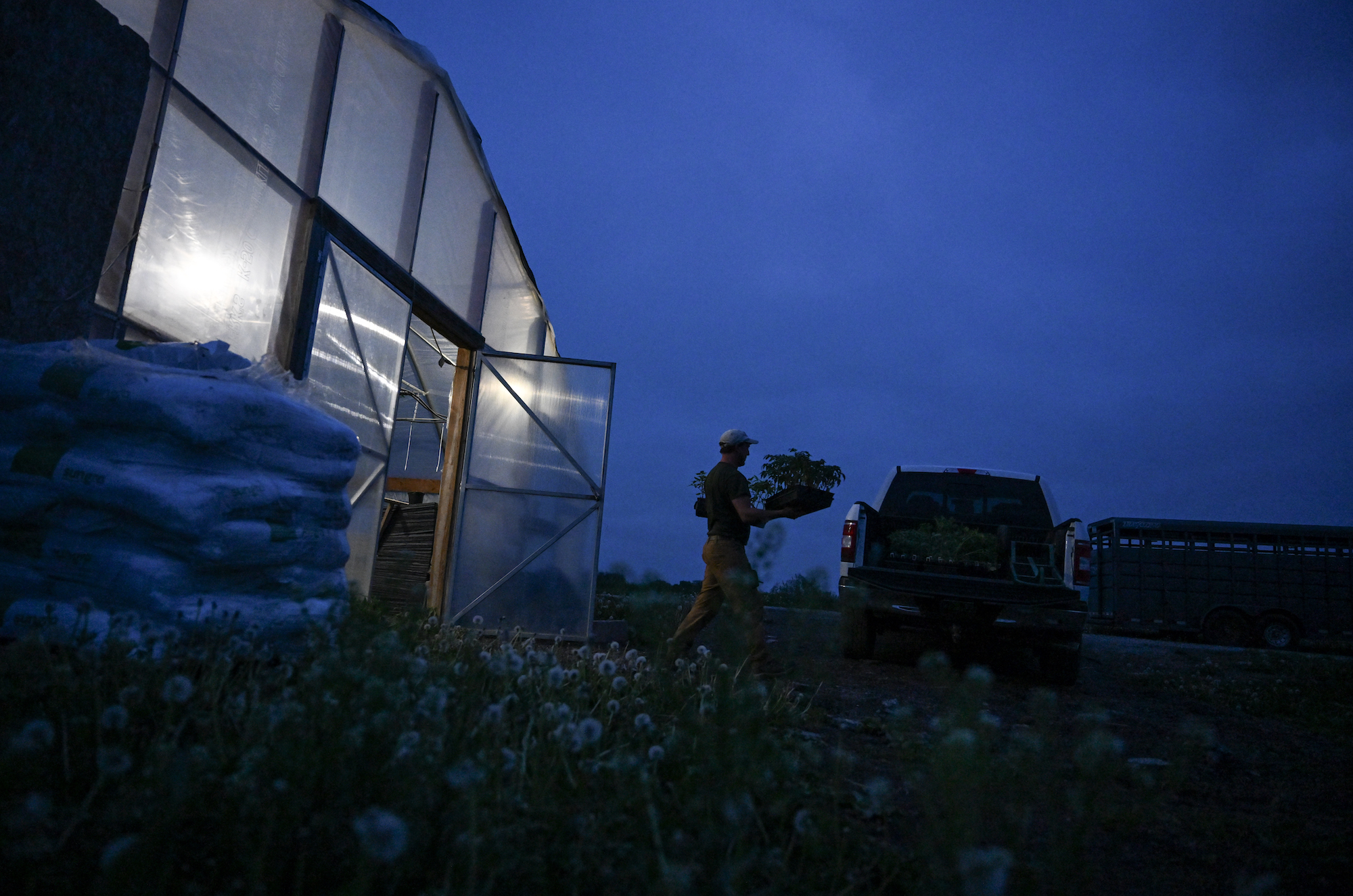
    A man gathers vegetables from a grow house at night
    Farmer Jacob Thomas pulls plants as he prepares for a farmers market the next morning on April 25, 2025 in Leavenworth, Kansas. He had a grant for a new distribution warehouse that was rescinded then regranted. Now he’s scared to proceed for fear it will be rescinded again.
    Ricky Carioti / The Washington Post via Getty Images

    Trump’s tax plan contains a slick budgeting maneuver that takes unobligated climate-targeted funds from the agricultural conservation programs in President Joe Biden’s 2022 Inflation Reduction Act, or IRA, and re-invests that money into the same farm bill programs. The funding boost provided by the IRA was designed to reign in the immense emissions footprint of the agricultural industry, while also helping farmers deal with the impacts of climate change by providing funding for them to protect plants from severe weather, extend their growing seasons, or adopt cost-cutting irrigation methods that boost water conservation.

    On its surface, the inclusion of unspent IRA conservation money in the tax package may seem promising, if notably at odds with the Trump administration’s public campaign to all but vanquish the Biden-era climate policy. Erin Foster West, at the National Young Farmers Coalition, calls it “a mixed bag.” 

    By proposing that the IRA funding be absorbed into the farm bill, Foster West says, Trump creates an opportunity to build more and longer-term funding for “hugely impactful and very effective” conservation work. On the other hand, she notes, the Trump megabill removes the requirements that the unspent pot of money must fund climate-specific projects. Foster West is wary that the removal of the climate guardrails could lead to more conservation money funneling into industrial farms and planet-polluting animal feeding operations

    The House budget package also omits many of the food and agricultural programs affected by the federal funding freeze that would typically have been included in a farm bill. Those include programs offering support to beginning farmers and ranchers, farmer-led sustainable research, rural development and farm loans, local and regional food supply chains, and those that help farmers access new markets. None of these were incorporated into the Republican megabill. 

    “It’s just a disinvestment in the programs that smaller-scale, and beginning farmers, younger farmers, tend to use. So we’re just seeing, like, resources being pulled away,” said Foster West. 

    Moreover, up until now, several agricultural leaders in Congress have expressed confidence about passing a new “skinny” farm bill, to address all programs left out by reconciliation, before September. Provisions in the Trump budget bill may erode that confidence. By gutting funding for SNAP and increasing funding for commodity support, two leading Republican farm bill priorities, the need for GOP legislators to negotiate for a bipartisan bill diminishes. 

    a building with two banners both saying USDA. One has a photo of Donald trump and the other has a photo of Lincoln.
    Banners showing images of President Donald Trump and Abraham Lincoln hang on the side of a U.S. Department of Agriculture building in Washington, D.C., in May 2025.
    Mandel Ngan / AFP via Getty Images

    Inherent to the farm bill are provisions set to incentivize Congress to break through its own gridlock. If neither a new farm bill nor an extension is passed ahead of its deadline, some commodity programs revert to a 1930s and 1940s law, which helps trigger what is colloquially known as the “dairy cliff” — after which the government must buy staggering volumes of milk products at a parity price set in 1949 and risk spiking milk prices at the supermarket. Trump’s tax package would suspend this trigger until 2031.

    Under Trump’s vision, encoded in the tax bill, U.S. food and agriculture policy would “cannibalize” itself, according to Mike Lavender, policy director at the National Sustainable Agriculture Coalition. The policies meant to make better food more available to more people, and support the producers that grow it, in other words, could make way for a world in which fewer people will be able to farm — and to eat.

    “It’s an irresponsible approach to federal food and farm policy,” Lavender said. “One that does not support all farmers, does not support the entire food and farm system.”


    donald-trump-recruited-by-kgb-in-80s-and-even-has-codename-claims-former-soviet-spy

    https://www.theguardian.com/us-news/2021/jan/29/trump-russia-asset-claims-former-kgb-spy-new-book


    https://archive.is/ohI5R


    https://www.the-express.com/news/world-news/163709/us-air-force-plane-spy-plane-lands-moscow-carrying-sensitive-cargo-after-putin-invite


    https://www.msn.com/en-us/news/politics/ex-soviet-spy-makes-sensational-kgb-claim-about-trump/ar-AA1zxhrZ


    https://www.the-express.com/news/world-news/163709/us-air-force-plane-spy-plane-lands-moscow-carrying-sensitive-cargo-after-putin-invite


    https://www.mirror.co.uk/news/us-news/donald-trump-recruited-kgb-codename-34726995


    https://www.independent.co.uk/news/world/americas/us-politics/kgb-spy-trump-asset-russia-b1794955.html


    https://bylinetimes.com/2025/02/21/donald-trump-was-recruited-by-the-kgb-under-codename-krasnov-claims-former-soviet-spy-chief/


    https://www.msn.com/en-us/news/politics/donald-trump-recruited-by-kgb-in-80s-and-even-has-codename-claims-former-soviet-spy/ar-AA1zwS2y


    https://www.dailykos.com/stories/2025/2/21/2305351/-Magic-Disappearing-DB-Story-About-Allegations-Trump-Was-Recruited-as-a-Russian-Asset


    https://www.dailykos.com/stories/2025/2/21/2305375/-Before-Trump-was-exposed-as-Krasnov-and-after


    https://www.dailykos.com/story/2025/2/21/2305257/-Krasnov

    climate of deception


     polar.jpg 

    GLOBAL WARMING bullshit


     recently released study by the scientists at the max ‘walk the’ plank institute reveal — This very expensive GLOBAL WARMING bullshit has got to stop. Our planet is freezing, record low temps,and our GW scientists are stuck in ice — trump tweets

    Friday, May 30, 2025

    the 40 days of trumpmas - a surreal serial poem


     guyhair1_517UcgHYK3L._AC_UL320_SR256_320_.png 

    Remember, remember! The fifth of trumpvember

     the 40 days of trumpmas - a serial poem


    for 40 days the trumpeter reigns,

    his lies and hate on whom he disdains,

    but election day will come so soon,

    we'll no longer hear the orange baboon;


    in 39 days full of world wide problems.

    we could elect him to get rid of the muslims,

    but as he'll rant on trivialities of his presidential life,

    what could be worse? - you could be his wife;


    in 38 days just what will you do?

    the donald has said he likes lgbtq,

    but as he bullies his women and all his men too,

    if youre questioning, what stops him from bullying you?


    in just 37 days, some people are saying,

    (or pleading or hoping or some even praying)

    the duke of prunes will dye his forelock purple my friend,

    and thus make america grape again,


    our days are down to just 36,

    before our problems the don will fix,

    he will on day one do what hes said - true,

    he'll wall out our enemies - and fat women too!


    on the 35th day of trumpmas

    yes just seven weeks remain!

    will the polls and tallies deliver us

    donald with his golden mane?


    34 days and the vice-pipers have piped,

    though pence didnt say why donalds suit shouldnt be striped,

    he wouldnt defend his master's string pulling,

    to make america great? - who do they think they're fooling?


    just 33 days till the macho tornado,

    unless its blown away by hurricane machado,

    with women and voters he has so much to loose.

    keep your mouth shut donald (unless youre changing your shoes)


    32 days and we’ve been hit by the big blowhard,

    donald spoke here in fla (oh, we had a hurricane too)

    this administration gives us playing the race card, a weak economy, and unemployment

    but if you want a job you could be donald’s campaign manager (unless youre a jew)


    31 days, just a month, remains;

    will the donald say hes sorry, and his baser impulses restrain?

    or keep blaming bill clinton for our moral demise;

    when trump speaks to us, our NO votes must be our replies!


    election comes this time (in 30 days) each 4 years,

    time for praise and tears and fears;

    as polls will open in many states,

    vote early, please dont vote late!


    down to 29, just a leap february,

    and theres still the donald quite

    contrary;

    donald donald, how does your garden grow?

    quoth the master debater, "with pretty maids groped in a row"


    just 28 days - later or soon,

    and the zombies will rise, led by the big goon;

    unless everyone gets a reality inoculation,

    i might have to move to canada for a well deserved vacation; 


    now just 27, less than 4 weeks,

    no time for you to say 'yikes!' or 'eeeks!'

    obama wants to go to mars and colonize it for man,

    lets send trump tomorrow! and colonize it for orangutan!


    26 days are all that remain,

    will our democracy and economy go down the drain?

    if we all keep listening to the blustering oaf,

    will he give jobs and prosperity? - or just half a loaf


    25 days - will more women speak?,

    of the antics of donald who the presidency seeks,

    dating 14 year old girls or groping their mothers,

    how did the gop pick him over the others?,


    24 days - were down to two dozen,

    the next woman who speaks just might be your cousin,

    or mother or sister, aunt, niece, even daughter,

    describing the circumstance in which donald caught her,


    23 days left and trump doesnt yet have as many accusers,

    as cosby, but he assures us that they are all really losers,

    sent by bankers or hillary with secret agendas,

    to disrupt our election of him - our defender!,


    22 days and we know charity begins at home,

    but donalds attention is so prone to roam,

    his gift that disappeared to 911 survivors from his foundation?,

    oops! maybe donald spent it on a vacation,


    21 days and trump says the election may be rig-ly,

    if hes not the winner and his total's not big-ly,

    tremendously higher than hillary gets,

    he warns his supporters may all lose their wits,


    20 days left and while george zimmerman still walks free,

    the man who shot at HIM got 20 years - while trayvon got eternity,

    trump wants us to support our cops and maintain law and order,

    he'll put all the inner city dwellers in jail, and send the immigrant criminals far across the border,


    19 days left till we all go to pretend,

    to elect someone to lead us, as if on it our lives depend,

    but wise man, donald trump, already really knows,

    who we really voted for - a wolf in president's clothes?,


    18 days and we bad hombres demand a rebate,

    on the ill feelings left since the comments of one candidate,

    the debaters have met in their final grudge match,

    but only donald can say from whose hands victory will be snatched,


    17 days and our government is corrupt with quid pro quo,

    did you take latin at wharton? is that how you know?,

    donald wants us to fire at them all - the bureaucrats lined up in rows,

    and believe me, corruption is a subject. that donald really knows,


    16 days - lets set term limits on all our office holders,

    and put all our women in binders - or maybe in folders,

    donalds endless complaints are becoming a sour whine,

    have a little cheese with that, from wisconsin, where 

    hillary's doing fine,


    15 days and on stocking covered thighs did linger,

    two miniature hands with two thumbs and eight tiny fingers,

    they belonged to the donald who believed that he owned,

    any thing that he wanted - or anyone he got alone,


    14 days yes only two weeks,

    till the duke of orange assends to the throne he seeks?,

    to rule all americans, the strong and the weak?,

    and dominate the globe with power that's peak?,


    the 13th day to go - does that seem unlucky?,

    not for donald whos lately been appearing quite plucky,

    claiming media, polls, and parties are against him,

    and rallying his multitudes with wit waxing dim,


    on the 12th day of trumpmas donald awoke with a jerk,

    promptly fired his latest campaign manager (who considered that a perk),

    if youre "AAAfroAAAmurikan" and unemployed i can put you to work,

    barked donald the businessman from behind his sly smirk,


    it's the 11th and engineer casey trump is in the caboose,

    i hear some of you saying oh no! what's the use,

    our campaign will probably just go off the tracks,

    but donald says its ok - cause he's got "the blacks",


    just ten days left yes only one-zero,

    til donald is hoping that he'll be your hero,

    as new hillary emails come under investigation,

    donald hopes to rename camp david to camp donald for

    his vacations,


    like a cat has nine lives we're left with only 9 days,

    till we're subject to donald? and his old wicked ways,

    on foreign affairs he says he'll save us from isis,

    but his domestic affairs are misogyny and crisis,


    our days are numbered - yes only eight,

    till once again we make america great,

    by getting rid of candidates who have nothing to add,

    goodbye donald you wont make america sad,


    just one week to go - its day minus seven,

    till america's lifted above - to trumpty dump heaven?,

    where for rich folks like donald opportunity abounds,

    and we keep the working poor with a wall that surrounds,


    how the time it does fly its already day 6,

    till americans problems the donald will fix,

    his solutions begin on trumpday number one,

    dont you like them? they'll come at the barrel of a gun,


    Five days to go, baby, One in five,

    No one here gets out alive, now,

    david dukes not opposed to all jews,

    he backs trump - who are you going to choose?,


    only 4 days left till the armaged-don,

    he'll seize power by the horns once he has won,

    and donnie will be what he longs for - a winner,

    using the FBI to wreak havoc on hillary the sinner,


    only three left, just a triad of days,

    and the donald his supporters continues to amaze,

    with hoopla and folderoll made up in his head,

    his winning temperament will leave us all dead,


    just a pair of days - 2 - till trump paradise,

    since these words you're reading please heed my advice,

    the creatures that surround us are beginning to bite,

    'blacks for trump' fear the Illuminati so lets turn out their light,


    just a single day left till our thanksgiving,

    deliver us from donald and preserve the living,

    forget sanity and disgard your misgivings,

    but pray hard to your gods that they'll be forgiving,

    since we've got the nukes why can't we use'em?,

    on the road to 2016 why couldn't we lose HIM?,


    and trumpmas now has finally come,

    the tallies will count up to a winning sum,

    unless the earth is struck soon by a cataclysmic comet,

    to elect a candidate who just makes you want to vomit?,

    we wish you a merry trumpmas at this time each 4 years,

    if you have'nt voted you've lost the chance to mitigate your fears,

    cause donald duck is ready to lead, forget your crocodile tears,

    so you'd better get the vaseline and lubricate your rears!